

We tend to think of genius as something you’re born with — a rare trait possessed by the Einsteins and Teslas of the world. But what if many of the abilities we associate with genius — a great memory, quick problem-solving, mental math, creative insight — are actually trainable skills?
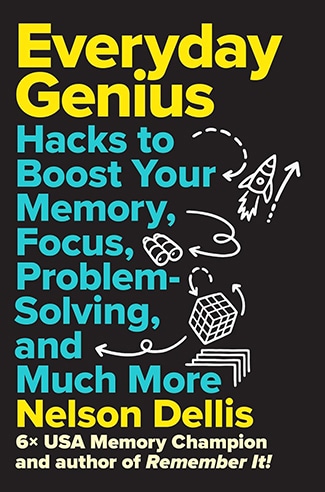
My guest today says that’s exactly the case. His name is Nelson Dellis, and he’s a six-time USA Memory Champion and the author of the book Everyday Genius.
In our conversation, Nelson explains why memory is the foundation of thinking well and why having information stored in your head still matters in the age of ChatGPT. He shares a practical technique for improving your memory, how to read with greater focus and retention, and how to study to actually make information stick. We then talk about the importance of developing “number sense” and how to convert imperial measurements to metric in your head, strategies for solving problems more effectively, and even how to gain an edge in the games of Monopoly and Connect Four. At the end of the conversation, we get into more esoteric territory, including intuition, dreams, and the idea of remote viewing.
Resources Related to the Podcast
- Nelson’s previous appearance on the AoM podcast: Episode #546 — How to Get a Memory Like a Steel Trap
- AoM Article: 10 Ways to Improve Your Memory
- AoM Article: How to Speed Read Like Theodore Roosevelt
- AoM Podcast #385: Learning How to Learn
- AoM Article: Study Tactics of the Successful Gentleman Scholar
- The CIA’s remote viewing program
Connect With Nelson Dellis
Thanks to This Week’s Podcast Sponsor
Incogni. Take your personal data back with Incogni! Use code MANLINESS at the link below and get 60% off an annual plan: https://incogni.com/
Listen to the Podcast! (And don’t forget to leave us a review!)





Listen to the episode on a separate page
Subscribe to the podcast in the media player of your choice
Transcript
Brett McKay:
Brett McKay here and welcome to another edition of the AoM podcast. We tend to think of genius as something you’re born with; a rare trait possessed by the Einsteins and Teslas of the world. But what if many of the abilities we associate with genius — a great memory, quick problem solving, mental math, creative insight — are actually trainable skills.
My guest today says that’s exactly the case. His name is Nelson Dellis and he’s a six time USA memory champion and the author of the book, Everyday Genius. In our conversation, Nelson explains why memory is the foundation of thinking well and why having information stored in your head still matters. In the age of ChatGPT, he shares a practical technique for improving your memory, how to read with greater focus and retention and how to study to actually make information stick. We then talk about the importance of developing number sense and how to convert imperial measurements to metric in your head, strategies for solving problems more effectively and even how to gain an edge in the games of Monopoly and Connect Four. At the end of our conversation, we get into more esoteric territory, including intuition, dreams, and the idea of remote viewing. After the show’s over, check out our show notes at aom.is/genius. All right, Nelson Dellis, welcome back to the show.
Nelson Dellis:
Thank you for having me. How you been?
Brett McKay:
I’ve been great. Thank you for asking. It has been a while. We had you on the podcast way back in 2019 to talk about memory sport because you are a USA memory champion and we talked about what that involves and how we can improve our memories. For those who aren’t familiar with memory competitions and they haven’t listened to that episode we did, what do they typically look like? What sorts of events do you encounter as a memory athlete?
Nelson Dellis:
Yeah, it’s a super fascinating competition. When I first saw it, I couldn’t believe what I was seeing people do and it definitely wasn’t something I thought, Hey, I could do that. I had to learn how to do it and practice it a lot. But they test you on all sorts of random information, so nobody has an advantage in terms of knowing stuff in their memory beforehand, but they give you a shuffle deck of cards, you got to memorize it as fast as possible. They give you a 500 digit number and five minutes to study it. You got to memorize as much of it in order as you can. They give you a whole packet of headshots with names and faces. I mean, you’ve got a, remember the first and last name of everybody in there. They give you a poem, all sorts of things. It’s basically information you got to memorize in a certain amount of time and memorize the most of it as accurately as possible under pressure against other competitors.
Brett McKay:
How did you get involved with this? You saw this and you’re like, that’s crazy, and how did you go from that’s crazy to I want to do that.
Nelson Dellis:
Yeah, well, I saw it and I thought, yeah, it would be cool if I could do that. It’d be amazing, but I’m definitely not capable. But then I read a couple books by some former memory champions and started to kind of see this pattern that people who competed in these things, nobody was really claiming to have an amazing natural memory or photographic memory, anything like that. They all kind of had a similar story where they heard about memory techniques, these ancient memory techniques, and then they practiced and then they got better. And to me, practicing memory sounded bizarre. I’d never heard of anything like that, that you could even do that to get better. And that kind of hooked me and I started applying the techniques and realized, hey, it actually does work, and my memory’s not as bad as I thought and I was hooked.
Brett McKay:
And then you also talked about, there’s sort of a personal angle to this as well. Was it your grandmother who got Alzheimer’s?
Nelson Dellis:
Exactly.
Brett McKay:
Yeah. Tell us about that.
Nelson Dellis:
That really started it all because I never really had memory on my radar. I had my own memory abilities. They were mediocre at best and otherwise I would’ve just accepted that for the rest of my life. But I saw my grandmother and her memory deteriorate right before my eyes. She had Alzheimer’s and eventually it took her in 2009. And it was that moment when I lost her that I realized, man, I need to do something about my own memory right now so that when I get to her age, this hopefully won’t happen to me. It was terrible to witness. And so I went down a rabbit hole of studying memory, and that’s when I discovered about these memory techniques and memory competitions.
Brett McKay:
Well, you got a new book out called Everyday Genius: Hacks to Boost Your Memory, Focus, Problem Solving and Much More. And what you do in this book is you make the case that genius isn’t necessarily something you’re born with. It’s a skill just like memory is a skill that you can develop. How are you defining genius?
Nelson Dellis:
Yeah, great question. It’s an interesting topic. I’ll preface it a little bit by saying, some people would look at me and just say, Hey, oh man, Nelson, he’s a genius, because they’d see me do these memory things and I’d be like, dude, I’m not a genius. I do not want that title. I don’t deserve it. I don’t think I am anything close to that. The thing that I do that makes you think that I’m a genius, I just learned it and practiced it. And it made me realize, especially for the purpose of this book, that genius is subjective and we can all kind of agree on certain geniuses out there, Albert Einstein, maybe even Tesla, people who just kind of socially have been accepted as genius. If you were to push them further and ask, well, why? Well, you’d be be like, oh, they were smart and Albert Einstein came up with relativity.
Or, I dunno if people could really explain why, but they kind of just hold these people that are publicly acclaimed geniuses as that just because it’s socially accepted, but that doesn’t really answer what is a genius. So I think, and I claim in the book that I think genius is something that we can all tap into, that we can all train, and I think if I were to define it, I don’t think it’s a gift. It’s really like a trained relationship with your mind. It’s having agency over your mind combined with broad working knowledge of the world. So having all this information that you’ve trained with your mind and can do with your mind, but being able to broadly use it across many different pockets of the world and world knowledge.
Brett McKay:
Do you make a distinction between intelligence and genius? Because I think oftentimes we use those words synonymously.
Nelson Dellis:
Yeah, exactly. I’d probably say that intelligence is more like your capacity for the things that you know or hold in your brain, which I think with the right techniques, even with memory techniques, you can always increase your intelligence, I think. But I think genius is more the application of your intelligence. And I think if you can do that in a very flexible, malleable way, I think you fall more into this. You are a genius category.
Brett McKay:
Alright, so you lay out some foundational skills. So this idea that genius is a skill you can develop, there are foundational skills you have to develop to become a genius. The first one is naturally memory. Why is memory the foundational skill of becoming a genius? And I think the other question we can explore too is why memorize stuff? If you can just use ChatGPT or Google.
Nelson Dellis:
Yeah, I mean first of all, I’m biased obviously as a memory champ, I’m going to say memory is the most important thing, but I truly do believe that and I think the reason why I started down this road, watching my grandmother lose her memory, it just showed me how important memory is to being human. Think about without it, who are you and who are you to this place, this world? It’s largely what makes us human. I’d argue it is the thing that makes us human is having a memory. So I think it’s the place to start. If you can hold information in your mind easier and pull from those stores that you have of information that you can then apply all that knowledge, as I said before, across a variety of domains. And that is the application of genius.
Brett McKay:
Something I’ve noticed in the past 20 years with pedagogy, how we teach people, teach kids, particularly in elementary, middle school and high school, there’s been this shift away from rote memorizations like, oh, just knowing the dates of battles, we don’t care about that. We want to teach students how to think. We want critical thinking, which I agree, knowing how to think is important, but I always come back to it’s like you can’t learn how to think without having stuff to think about.
Nelson Dellis:
Exactly.
Brett McKay:
It’s like telling a kid, Hey, we want you to learn how to build, but not giving them blocks to actually build.
Nelson Dellis:
Yeah, no, I’m glad you said that. It’s totally the experience that I’ve had as I’ve tried to teach this stuff to as many people as possible. I’ve naturally been brought to schools to kind of see how we can infuse memory techniques into the curriculum, and it’s been such an uphill battle because I get faced with that fight where we don’t memorize. Memorizing is bad, and the reason I think that’s the case is because nobody ever taught how to memorize. So they’re doing it wrong. They’re doing rote repetition, which is tedious and boring and doesn’t offer good results. Imagine if you could just in a fun way, memorize something quickly, and that’s just not an important part about the whole process of learning anymore. It’s just the easy first thing you do and now you have the information in your mind. Now you can truly start to learn because the information is all in your head. You did it very quickly and it’s in a format that can be easily recalled in an enjoyable way. I argue that get the information in your brain quicker. That’s the easy step if you have the right techniques and then we can talk about learning and understanding and thinking because that information is in there and you can act on it,
Brett McKay:
Right, yeah, you can start remixing the stuff in your head and using it in different ways, but if it’s not there, you can’t do that. I mean, we’re going to talk about doing mental math in your head, but in order to do that mental math, there are some things you have to have memorized.
Nelson Dellis:
Yeah, exactly. Going back to the question you said about AI and Google searching, why bother memorizing? Well, I mean, sure, there’s obviously a possibility that one day pull the plug, nothing works. What are you left with? Just your mind? And if you know nothing, then you’re in a terrible spot, but that’s probably unlikely. So then why memorize anything if it’s always just a click or a search away? Well, I argue that I think going back to what I said before that to be human is to use your memory. And I think in this day and age where AI is threatening to take away our agency over our own brains, our cognitive skills even more so reason to use our memories and flex our muscles and kind of feel what it’s like to own that agency over our brain, the thought of losing that seems devastating to me. I don’t know how other people feel about it, but I don’t want to lose that capacity. So I work on it and I make the effort and I feel good about it. I feel like there’s this confidence that comes from being able to do things with your own mind.
Brett McKay:
Yeah, I agree. So in our last conversation, that was episode number 546 for those who want to check it out, we go into detail about how you can improve your memory. We’ll kind of do a summary here. One of the things I remember from that conversation that stuck out with me was this framework for memorization that you called See, Link, Go. Can you walk us through an example of how you can use that to memorize just about anything?
Nelson Dellis:
Yeah, so when I wrote that book, I wanted to distill down the steps I took when I memorized anything in competition or in life into simple steps. So see link go, and that’s really what I apply and what I teach for anybody who wants to memorize anything, each step has its own little nuances, but in general, the first thing you got to do is see the information in a way that our brain likes to see things. And that is in the form of pictures, associations, things that are meaningful. Oftentimes in the day-to-day we’re faced with information that’s super abstract, complicated, not that interesting, and our brain just tunes it out even though it has the best intentions to memorize it, it just doesn’t like, it just doesn’t stick. So if you can see the information or turn it into a picture, a mental picture, that’s the first step to memorizing anything.
The next step is link. So what do you do with those pictures? And this is really, I think the crux of the problem for most people that when they memorize and then they try to remember something and they can’t, it’s not that they really forgot. In some cases, yes they did, but most of the time it’s that they just couldn’t retrieve the information. They know, they know it. And maybe if somebody had told them what they’re trying to think of or they saw the answer, they’d be like, ah yes, now I remember they recognize it and if you can recognize it, that means it was in there. You just couldn’t get it. So it’s a structure organizational problem there. And the link step is taking advantage of what our brains are really good at, and that is remembering the spatial information. So we’re good at remembering things around us, distances between things where we are in space, and so if I can attach my images to places, I can think about my house, I know my house, my office, my school, whatever, you have a better way of memorizing the information because attached or linked to a location and you don’t have to attach it to an actual location.
But that is one of the best methods that memory athletes use in memory competitions. That’s the thing that lets us memorize hundreds of cards and thousands of digits all with this what’s called a memory palace. And then the last step, the go step is really what you do with that information. So if you want the information just for five minutes and then you can lose it, cool. If you want to keep it forever also cool. It’s how you treat basically the information that you use in those first two steps. If you organize your information with the link step and you saw or see the information in the right way, in a memorable way, that go step is how long you can interact with that information and you have control over that. People ask me all the time, how long can you memorize this for? How long until you forget it? And it’s like, well, as long as I want, I can choose. It’s what I do with the information once it’s stored in my mind and because it’s organized in a way that I can remember, it’s really easy for me to store information and keep it there for the long term.
Brett McKay:
Can you give us an example of maybe something really easy about how you can use this framework to memorize an everyday thing that someone would maybe want to remember?
Nelson Dellis:
Yeah, sure. So let’s say grocery list. Okay, so let’s say you have a few items on your list. I’ll keep it super short, but let’s say we have three items on our list. You could probably memorize three things, but imagine extrapolating this out to a list of say, 10 to 20 things, but let’s say that you have to get milk, some broccoli and some bread. So first thing is to visualize or see those things individually. So for milk, I would picture actual milk, like a glass of cold milk, maybe there’s a cow spraying milk out of its utters. So part of the see process is to make it as visually … as possible using all of the senses. And the more emotion you can add to these images that you see the better. So a glass of cold milk there, that’s okay. I’d give that a five out of 10 on the memorable scale, but a cow spraying milk everywhere out of its utters and mooing and you’re covered in milk now and it’s kind of like filthy milk straight from the barn that’s closer to a 10 in the shock value and emotional side of things.
So you’ll remember that better. Alright, what about the next one? Broccoli. Okay, so maybe I can just imagine a huge forest of giant broccoli stalks and I’m walking through this broccoli forest and then for bread, maybe I’ll go the route of something disgusting so that the bread is just covered in mold and it’s kind of fuzzy and green and rank smelling and withering away. That kind of evokes a disgusting kind of response, but memorable, that’s the see part. Now the link part is how do I attach that to something so that I can retrieve it easier? If you use a memory palace, you could imagine attaching those three images to places in your house. So maybe on the front door is where I imagine this cow spraying all the milk. So I’m covered in milk, but so is now my front door. Then I walk in the front door and there’s my broccoli forest, I’m walking through it, there’s broccoli everywhere, these tall broccoli trees.
And then maybe to the left, if I turn to the left in my house after entering the door is the TV room and that’s where there’s piles and piles of moldy bread. Just like my couch is made of moldy bread, my TV is made of moldy bread and so on. And you can navigate around your whole house doing this whole process with more things. And so now when I’m at the grocery store, if I want to remember this, I’m going to say, oh, it was in my house. What was at the front door? Oh yeah, that was the thing covered in milk. The cow was spraying it to high heaven. So milk. Then I walk in the door, broccoli, then I go to the TV room, moldy bread, bread. So that’s just a little taste of how the process works.
Brett McKay:
Yeah, that’s really cool. I’ve actually used this system for whenever I parked my car at the airport in the parking garage because you get back from the airport and you don’t remember you parked. And so you spend 20 minutes trying to remember where you parked the car. So now whenever I park my car, I look at what section I’m in and say if I’m in, let’s say section B, I think, okay B for bread. And then I just imagine my car filled with just a ton of loaves of bread or if the parking garage uses colors for their system, and let’s say you park in the red section, you could think about your car being filled with red blood and when you open the car door, all the blood pours out. So yeah, that’s going to sear in your head. So yeah, I’ve used this tactic that you shared in our last conversation, and I think the key with all the memory techniques is that memory is a skill, so you have to practice it all the time. So just look for opportunities throughout the day to practice your memory. So whether you can memorize your grocery list, memorize dates, memorizing the names of people, just do it all the time and you’re going to get better and better at it. So another foundational skill you have for becoming a genius is speed reading. Why is this a foundational skill?
Nelson Dellis:
And I’d like to slightly alter the word choice there. So I do title my chapter there, a speed reading, but I quickly change it to focused reading. I think speed reading can often get labeled as kind of a hack or a scam, and there’s definitely programs out there that promise tens of thousands of words per minute, which I don’t know if I fully believe that sure, anybody can read at x thousand words per minute, but do they remember anything that they read? But what I talk about in this chapter are real practical ways to actually improve your reading speed. I think we can all do that and increase our reading comprehension. There’s definitely room there to do that. And we do measure how fast we read by words per minute, how many words you get through in a minute, and this is a fixed number, but you can increase that and I think it does vary depending on what you’re reading.
If you’re reading something to your five-year-olds, that level of reading, probably you could zip through at an extraordinary rate. But if you’re reading a dense biology textbook, that might not be as fast. So yes, you can measure reading speed, but it’s also subjective and depends on what you’re reading. So hard to measure. And speed reading doesn’t always make sense as well. Why would you want to speed read through Lord of the Rings and The Hobbit or Harry Potter? You probably want to enjoy those and take your time and reread parts. But there’s other times where you’re just trying to get through an essay that somebody wrote, you’re grading it and you maybe want to go through it a bit quicker. You got dozens to grade. So reading faster and being able to remember more. If you have the skills you can kind of pick and choose when you want to increase your speed, slow it down, always remember as you read through.
Brett McKay:
Right. So what are some quick tips on how you can just read faster that you can start implementing today if you wanted?
Nelson Dellis:
Yeah, I think some of the things that are holding people back is first, often this is obvious is distractions. We live in a world where everything is vying for our attention, especially all the devices around us. So eliminating that or quieting those better and being more intentful with the time that you read. If you want to sit down and get through a book, make that time all about that. Don’t sit down to read with your phone open, go into it thinking, I want to be there present with this book. So eliminate distractions, find places that are easier to read in, not with your kids all around you jumping over you and maybe find a quiet, peaceful place if you can. I have four kids, that’s not always easy, but anyways, distractions is a big part of it. The other thing is backtracking. So when we read, we often find ourselves backtracking.
You might get through a few lines only to realize that you were not there and you maybe have to go back and reread something. So what I find helps, and this feels like you’re doing something that kindergartner might do, but I do it and I have no shame. I put my finger on the page or sometimes I have a pen and I will guide my eyes across the page where my fingers are and it forces me to stay on track and not backtrack because my finger keeps moving and I follow my finger. It’s a bit weird to do at first, but you get super comfortable with it after a very short amount of time. The other thing is I’ll quickly say this is practice. Like anything, if you want to get better at reading, read more. You kind of feel out of practice when you don’t read a lot and it’s harder, there’s more friction to reading when you don’t do it for a while, but the more you get into it, you find that you just become a better reader. Yeah,
Brett McKay:
I agree. And another tip that I use when I’m speed reading is, and a lot of people do this, is eliminate subvocalization. So that’s whenever you’re reading silently, but you might be moving your lips. Don’t do that. Just try to see the word and just move on.
Nelson Dellis:
Yeah. I also think if you eliminate subvocalization, it forces you to rely on visualization more because I mean you are reading the words but you’re not saying them to yourself to process them. You’re probably coming up naturally with some kind of visual in your mind to represent what you just saw and moving along. And the more you can do that actually you’re going to make it more memorable as well, tapping into that see part of memory.
Brett McKay:
Alright, so read faster or more focused reading and this going to allow you to learn more. If you can read more, you’re going to be able to learn more. Another foundational skill is learning how to study better. How do people typically mess up studying? And if this is going to be useful, if you’re in college right now or you’re an adult and back in school, but we all have to learn new things, whether it’s on the job, you have to learn a new skill. So this is important. How do people typically mess this up?
Nelson Dellis:
Yeah, I mean I think it starts with similar thing to what I said with reading is finding the right place to sit down and avoid distractions. Eliminate distractions. Finding your focus zone and just making it so that when you study it’s all about the information that you’re sitting with and nothing else. That’s a place to start. I mean it’s not the end all be all, but you can’t have a good study session if you’re not paying attention.
Brett McKay:
One thing, the other thing I was going to say, one thing I remember, we had a guy on the podcast, what was his name? Peter Brown. He wrote a book called Make It Stick. And one thing I remember that stuck out for me, yeah, it stuck out book’s called Make It Stick… ithat learning should feel hard at first. If it feels easy, you’re probably not learning. And I think we talked about how some of these apps, these language learning apps like Duolingo people like it feels easy. You’re like, oh man, I’m racking up points and I’m not breaking my streak, but you’re actually probably not learning the language. It feels like you’re learning, but you’re probably not because pretty easy. So if it doesn’t feel like you’re pushing yourself, you’re probably not learning.
Nelson Dellis:
Yeah, exactly. And that gets more into the techniques to remember things for longer, which is what you want when you’re studying and trying to learn the information. Yes, you want to memorize it, but you also want it to stay there for longer. And through your study sessions do things that will give it a higher chance of staying there. And one of the things as what Brown was saying is if you can make yourself a little uncomfortable as you try to say recall this information and pull it from your memory at first it’s going to feel uncomfortable because it’s new information, you don’t quite know it well and you can always just peek at the information. That’s the easy thing, right? That’s passive review. But if you can do something called active recall, which is where you actively try to pull it from your memory, that’s where the magic happens.
And even though it’s kind of like an uncomfortable part of the process, that’s where the actual remembering for the longterm the understanding comes from. And if you can pair that with another technique called space repetition where you basically space out your review sessions, that’s really the gold standard for studying. Well, we forget things over time. That is a fact about the human brain. And there are charts that show this thing called a forgetting curve. Like all humans experience this and we all forget kind of at the same pace. But if you review at a certain amount of time passed after the first review, you forget less, that forgetting curve doesn’t dip as much. And then if you review again after a certain amount of time that forgetting curve almost starts to level out and things don’t get forgotten, you have a higher retention. So being able to space out your study sessions is super important to studying more effectively. And this is why cramming doesn’t work because you do it all in one set and you know it for about X amount of hours and then it starts to forget as the curve suggests, and then the next morning when you take the test, oops, it’s all gone.
Brett McKay:
Alright, so with those foundational skills established, so we got memorization reading in a focused manner, studying more effectively, let’s get into the fun stuff because this is my favorite part of the book. It’s just all these little tricks, hacks that you can do that just make you feel and look like a genius. I’m talking doing mental math, solving complex problems on the fly. One thing I’m always impressed by is people who can do math in their heads beyond basic arithmetic. So I’m talking multiplying three digit numbers, doing square roots in their head, long division in their head. And you argue that people who can do mental math, what they have that most people don’t have is number sense. What is number sense and why do you need that for mental math?
Nelson Dellis:
Yeah, I think it’s super important. I think number sense, if I had to define it, is a comfortable relationship with numbers. And I feel like a lot of number sense is dictated by how you were taught as a kid and how you were exposed to numbers. If you look at numbers objectively, they are just symbols that interact with each other. And as a young student you learn these relationships and they can easily be frightening and discouraging if you don’t get those relationships explained to you. But I don’t think it’s too late to change your relationship with numbers. I think it’s just a matter of getting better at grasping quantities and magnitude, getting more playful with numbers and noticing relationships and patterns and then getting more flexible with how you think about numbers. And some of the techniques that I show in this book, hopefully open the door to that and I think you should just be encouraged to explore numbers and try to look at numbers for what they are. They can be really inviting if you let them. And the more you play around with that, I think you build on that number sense. It’s also, I think largely based on confidence. If you’re not confident in your number ability, you probably don’t have good number sense, but as you build the number sense, you probably build on that confidence as well.
Brett McKay:
So it can be developed and you walk through how you can do different math operations in your head, whether it’s multiplying long division. But I want to talk about two that I think could be really useful that people can use on the daily. And I know I’ve used this trick in my own daily life, I think a lot of Americans find it useful. It’s converting from imperial measurements, we’re talking like freedom units, pounds, inches, et cetera, to metric and then doing it backwards. I’ve encountered this with my fitness training. Oftentimes you’ll see body weight given in metric and I’m like, okay, what’s 90 kilograms? I don’t know what that is. Like, okay, you can do this in your head really fast. So let’s talk about this. How can you convert miles to kilometers in your head?
Nelson Dellis:
Oh yeah, we can start with miles. So if you have miles going to kilometers, that’s times 1.6. So you got to be able to do multiplication by 1.6 in your head, which isn’t obvious to most people. Now the quick way is just to say roughly if I can figure out how to multiply by 1.5, I’d be close enough. And that’s actually pretty easy. If you think if you’re multiplying by one, that’s just the number itself, and then you’ve got another half. So all you’re really doing to translate between miles and kilometers is adding half of the number to itself. That would give you one and a half times. So let’s say I had eight miles and I wanted to convert that to kilometers. The quick way half of eight would be four, and then you just add that to eight. So eight plus four is 12, so it’s 12 kilometers roughly. If you want to be super accurate at that point you can just add 10% of the original number and 10% of anything is super easy, you just move the decimal over. So if I had eight miles, 10% of that is just 0.8, right? So if I have 12, I add another 0.8, it’s 12.8
Brett McKay:
Bam. What about converting kilometers to miles? Because let’s say you’re an American in Europe and you see, oh, I’ve got 35 kilometers to Berlin, and you think, well how far is that? I don’t know how far that is.
Nelson Dellis:
Yeah, well yeah. So if you want 35 kilometers, you’re going the other way around, it’s really just half it that’ll actually get you pretty close and then you can add another 10%, right? So if you have 35 kilometers, if you have that, again, you don’t have to be super accurate, but you can just say, okay, that’s 17. But if you know it’s 17 point a half, which is half, then awesome. Alright, and then you add 10%, what was 10% of 35? That’s just the 3.5. So if you have 17, 17 point a half plus three and a half, you have 21 depending how accurate you want to be. So that’s 21 miles.
Brett McKay:
Wow. Okay.
Nelson Dellis:
So the quick way is if you’re going to kilometers from miles, just add half of the number to itself. If you’re going the other way, just half it to keep it simple and you can always play around with that extra 10% if you want to be super accurate.
Brett McKay:
What about pounds to kilograms?
Nelson Dellis:
Oh yeah, pounds to kilograms is super easy. There’s 2.2 pounds in a kilogram, so you can pretty much just double your pounds and then add 10% or just double, and that’s close enough. It depends how accurate you want to be, but let’s say that you’re 200 pounds, so you could half that and then take 10% off. So if I’m 200 pounds, half of that is a hundred, and then 10% of that is just 10. So take 10 pounds off and that’s 90,
Brett McKay:
90 kilograms.
Nelson Dellis:
And then the other way you would double it. If you have kilograms, you double it and then add 10%. So let’s say you’re 40 kilograms, so if you double that, that’s 80 and then you can add another 10%, that’s eight. So it’s 88 pounds.
Brett McKay:
Okay. What about Celsius to Fahrenheit? I’ve encountered this when I’ve had guests that live in Europe and they tell me, oh, it’s been so hot here, it’s been 30 degrees Celsius. And I’m like, what is 30 degrees Celsius? And then I had to look it up like, oh my gosh, that’s only 86 degrees Fahrenheit. That’s not hot. So how can you make those conversions?
Nelson Dellis:
Yeah, so there’s a whole formula, but I think to get close enough, the real easy way if you’re going from a Fahrenheit to Celsius, take away 30 and then half that number. So if you have, I don’t know, let’s say it’s a hundred Fahrenheit. What is that in Celsius? You take away 30, so that’s 70. And then if you half it, that’s just 35 Celsius. Okay. Alright. And then the other way around, if you have Celsius, let’s say you have 35, you would double it first and then just add 30. So 35 double to 70, add another 30, you get back to a hundred.
Brett McKay:
Okay, a hundred. So 35, that’s hot, 35 degrees Celsius. So when someone says it’s 35, I’ll be like, that’s hot. If someone says 30, I’m like, man, that’s a nice spring day in Oklahoma. Another thing you talk about is solving complex problems on the fly. This is something you’ve seen a lot of geniuses do. Einstein, Tesla for example, did you uncover a framework that they typically use for that?
Nelson Dellis:
Yeah, across all these people we label as genius. One of the things that they all share is that they can solve problems. Well, I think the number one thing to understand about being good at solving problems is that a lot of these people are always trying to solve problems. One of my friends, and there’s a whole section on this about solving puzzles and difficult riddles and stuff, and one of my friends is just so good at them, but that’s all he does. He knows them all. He knows all their tricks, he knows all the kinds of answers that you typically get from these riddles. And so I asked him once, I was like, Wes, how are you just naturally good at these? He’s just like, honestly, I just do a lot of ’em. As you encounter a lot of problems, you start to, I guess in his case, he picks up on these kinds of patterns that typically solve these riddles.
And that’s a big part of being good at problem solving is recognizing patterns and making analogies to those patterns. Now, aside from that, that’s not just it. There’s more to it than that. I think being able to define a problem as basic as possible, there’s this idea of first principles thinking where you look at the problem at hand and you try to just at least to start strip it down to its most basic truths and then you build from there. It’s like looking at a problem and say, what do I know for sure what is here? That’s a crucial part to solving any problem. Some people don’t even think about that. They look at a problem and they feel overwhelmed, they just don’t know where to start. But always start with those first principles and then look for patterns and then experiment, iterate. So a lot of these geniuses who were good at problem solving weren’t figuring it out on the first try. They were just trying things over and over again. When Einstein came up with a lot of the things that he did, he wasn’t just coming up with it right off the bat with nothing before that he was building off of other people who had problem solved step-by-step to get to the next discovery. And he built off of that. But he also tried a million different things and some failed and some came through.
Brett McKay:
Alright, so again, the key is practice. These things you just talked about, practice finding first principles, finding patterns, and then experimenting. One way you recommend practicing is just doing riddles and puzzles all the time, and that just helps you learn the practice, those skills on the fly. Is there a puzzle that you really like when someone asks you like, oh, what’s a puzzle I could do that can really help me with my problem solving skills? Do you have one you like to go to?
Nelson Dellis:
Yeah, there’s one that I include in the start of that chapter because this is asked, I dunno if it’s asked this much anymore, but it is a famous interview question and there is a right answer, like an actual physical correct answer, but there are so many creative answers as well. And I think it’s just a fun exercise to think about and see what you come up with. Because I think any answer, not any answer, but a lot of answers can be valid. So the question goes like this, so you’re shrunk to the height of a nickel or something really small and you’re thrown inside a blender and your density is the same as you would be a normal size. The blades start moving in a minute, what do you do? How do you get out? And so you think, okay, well it’s a glass container, I probably can’t just climb out, I’ll slip down. Maybe I can just duck and I’ll be so small that the blades will miss me, but oh shoot, maybe the air currents that will form will lift me up and move me all around and I’ll die anyways. So what do I do? But anyways, I’ll encourage your listeners to maybe think about how to do that. I don’t know if I should give the answer, but
You can look up the answer if you want. Yeah,
Brett McKay:
The answer is it’s pretty obvious once you think about it a while. So yeah, we’ll let people figure that out. Noodle on that. You have this fun section about how to win several common games. So I’m talking Monopoly, Connect Four, and a lot of these games, they’re called solved games. Once you learn how to do the thing, you can win it pretty much every single time. Not all of them, but I mean for the most part,
Nelson Dellis:
Let’s just say you get an advantage.
Brett McKay:
Yeah, let’s talk about it. I think this is fun. If you’re playing your nephew or your niece, you want to be the evil uncle who just destroys them and demoralizes them. So what’s the best strategy to always win Monopoly?
Nelson Dellis:
Oh yeah, well, yeah. So before that I should just say that this whole chapter is about how to beat games in situations that are game-like, because oftentimes if somebody is just always that person that can win at something, they tend to be thought of as genius. How do they know how to do it? They always win this game. Every time I play Monopoly, I always lose, I can’t beat this guy. He must be a genius. But yeah, there’s a lot of components to Monopoly, for example, in a lot of these games. But there are little things that if you knew that might help you kind of have an advantage. If you invest in orange and red properties for example, those are the best because statistically they get landed on the most, more than any other spot. So you get people landing on it having to pay you what else? You could focus on three house sets. So the houses are super more cost-effective than the hotels. So you could focus on putting up those house sets rather than getting the hotels. Yeah, things like that.
Brett McKay:
Yeah. What about Connect Four? If you’re playing your kid, what can you do?
Nelson Dellis:
Yeah, the main thing with that is just to always start in the middle. If you play perfectly, meaning you’re trying to build up your rows of four and you start in the middle, it’s really difficult to lose there. And then thinking about ways to force your opponent to not having other options. You can stack your pieces in ways that create these double win conditions where it’s like you could win, if you put a piece here, you could win if you put a piece there and then your opponent has no choice but to choose one of ’em and then you win with the other. Yeah, but the quick tip there is just put your piece right in the middle as soon as you can and start from there.
Brett McKay:
Gotcha. Alright, I want to end on this. You have this last section where you get metaphysical, you’re a pretty rational guy, but lately you’ve been exploring Art Bell type stuff, extra sensory perception, remote viewing experiments that the CIA did where they’d hire these people who possibly had ESP and they could remote view nuclear secrets in Russia from Virginia. It’s really weird stuff. How did that happen? How did you get into this?
Nelson Dellis:
Yeah, first there’s a reason why I put it at the back of the book. I wanted to make sure that the book was all very practical things that everybody could get on board with. I understand that this chapter is definitely a bit out there and definitely something five years ago I would’ve never thought I’d write a chapter on. I had an interesting experience happen to me in 2021 because of my memory stuff. I was reached out to by some people who were interested in having me join a remote viewing team. I’d never heard of the term at the time and was extremely skeptical of the whole thing. I was like, are you kidding me? I’m not psychic. I have no ability there whatsoever. I have a good memory that I trained. That’s about it. But they were convinced.
Brett McKay:
What is remote viewing for those who aren’t familiar with it?
Nelson Dellis:
Yeah, so remote viewing is the term given to this ability to see things that are not in the realm of things that can be perceived. So it’s psychic ability in a fancier term, but it’s really a protocol to kind of tap into intuition. I think that’s maybe a better way to place it. I think more people can resonate with that. I think we all recognize at times that we can have these eerily accurate intuition come over us, and that’s really what remote viewing I think takes advantage of if you want to label it as something that’s tangible and acceptable to most people. But yeah, there were military programs through the seventies, eighties, and the nineties. These are declassified. You can look them up on the CIA website and see actual programs and what they did, and they were using it to gather intel, finding downed military planes in the Sahara Desert or looking into silos in Russia during the Cold War to see what was there. And there were these psychics that were sitting in a room with absolutely no information, getting information that was later verified. Remote viewing is the protocol in which to do this process.
Brett McKay:
So here’s one version of a remote viewing protocol that you highlight in the book. So you need two people, one’s a tasker and the other is the viewer. The tasker picks a target, so it can be an object, a place, event, whatever. And then he assigns it a random number and there’s no inherent meaning of this number. It’s just numbers, a random number. And the viewer, he gets that number and nothing else. So there’s no hints about the target, there’s no photos, no descriptions of the target, just the number. And then the viewer gets to work. And so what he does is you got to grab a pen and paper and you write down the target number in square brackets at the top of the page. And then underneath that you write your name, date, and time below that you write the sentence. This session is about to begin.
And then after that sentence beneath that, you rewrite that target number without brackets. This time now begins like this weird part. So immediately after you write that number again without thinking, without hesitating the viewer, you put your pen on the page and you make this quick spontaneous scribble next to the number. It’s random. Whatever comes out, comes out. This little scribble is called an ideogram. This is your first unconscious connection to the target. Then what you do after you drew that little idiogram that scribble, you hover your finger over it like an antenna. And then while you’re doing that, you’re supposed to think about all the broad impressions you’re getting. So are you seeing a landscape? Are you seeing structures? Are you seeing motion energy? So this is called your gestalt. So it’s sort of a vague wide angle signal. So you just write down general impressions and then after that you draw a horizontal line and then below that horizontal line you start writing descriptor words.
So like colors, you’re seeing textures, you’re seeing your head smells, sounds, emotions, shapes. You don’t have to name specific things, but just kind of descriptor words and then just kind of stream of conscious. And then after you do that and things start slowing down, you sketch what you’re sensing. So you’re not trying to sketch the target yourself, you’re just trying to sketch these things. You’re seeing your head shapes, lines that are coming through, and then when the flow stops, you write in and big letters at the bottom and that’s your remote viewing session. Then you look at this to come up with what the target might be and what’s cool about this, you provide some practice remote viewing sessions in the book for people to try. So you give target numbers and they can go through this process to see if they can remote view the object you had in mind when you created those target numbers.
So that’s a remote viewing protocol and maybe there’s something to it, maybe not, but I am sure a lot of people are going to be skeptical about it. But I think the thing you’re trying to hit home here with this section is that there are things you can do to develop your intuition genius and you provide practices to enhance your intuition. Meditation is one, paying attention to your dreams is another. And you point out the fact that a lot of geniuses got ideas from their dreams. Salvador Dali, Paul McCartney, he got the tune for Yesterday in a dream.
Nelson Dellis:
He had it in a dream and he woke up the next day and swore that he had come up with a melody that he had heard somewhere else, and he was frantically asking around if anybody knew what song this was, but it was yesterday and that came to him in a dream.
Brett McKay:
Yeah. One of the practices you recommend is keeping a dream journal, so you just get yourself a dedicated notebook for this, and then you write down your dreams every morning immediately after waking up, and you want to do this as soon as possible because everyone knows how quickly dreams evaporate. And even better is if you write things down, if you wake up in the night, and so you just do this as much as you can. The more data you have, the more insights will come, and over time you’ll start recognizing or seeing recurring themes and symbols and patterns. Do you keep a dream journal?
Nelson Dellis:
Yeah, I go through phases where I feel like I’m looking for an answer to something and sometimes meditation will help me get there, but I also will maybe then explore my dreams because I find that my dreams often will communicate to me if I’m paying attention. I think the world around us will communicate with us if we pay attention, and building intuition is listening to the signals around us that we might typically ignore. Not everything has to have meaning. Not everything is a sign, but I think it’s super powerful to look at things as if they might be a sign and trying to notice patterns and just trying to not filter out that which we think is just noise.
Brett McKay:
Well, Nelson, this has been a great conversation. Where can people go to learn more about the book and your work?
Nelson Dellis:
If they head to my website, nelsondellis.com, it’s all there. I put a bunch of content out on YouTube with fun videos on how to improve memory, how to remote view, how to do all sorts of things that are talked about in the book. And yeah, the book’s called Everyday Genius. It’s a passion project of mine. I kept this little journal through high school and college and all the way up to recent days where I would just always write down really cool things that you could do with your mind that seemed genius. And there’s tons of memory stuff in there. There’s how to count cards, there’s how to solve Rubik’s cubes blindfolded, and that’s all kind of what got piled into this book.
Brett McKay:
Yeah, it’s a fun read. We just really scratched the surface with this stuff and there’s so much more for you to dig in, so I encourage people to go out and pick up a copy. It’s a lot of fun. Well, Nelson, it’s been a great conversation. Thanks so much for your time. It’s been a pleasure.
Nelson Dellis:
Yeah, thank you so much, man. Looking forward to hearing the show.
Brett McKay:
My guest today was Nelson Dellis. He’s the author of the book Everyday Genius. It’s available on amazon.com and bookstores everywhere. … As always, think for the continued support. Until next time, this is Brett McKay reminding you to not only listen to the podcast, but to put what you’ve heard into action.